


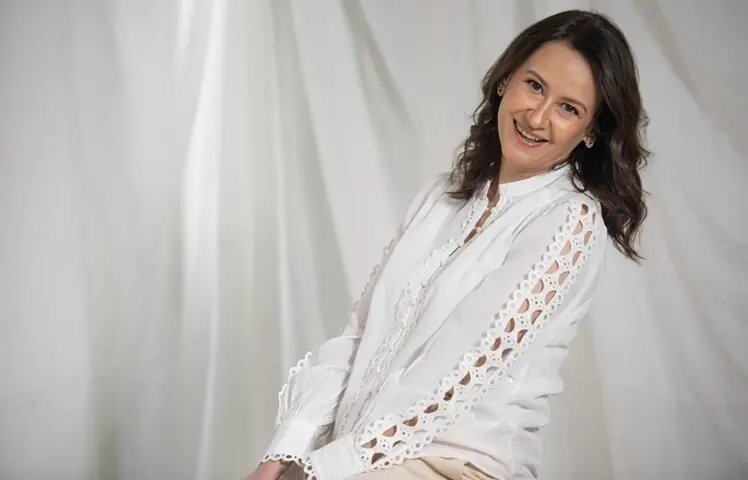
It is said that actors are half-mad. You do have to be a little crazy to want to do this for all your life.” Arjumand Rahim says this, smiling wisely, like someone who has figured out a method to the madness.
With a career that spans three decades, Arjumand knows the ups and downs of the entertainment industry and has ridden the waves as they rolled up high and then crashed down. There is grit beyond the glamour of an acting career, and Arjumand has always been one of the very few to address different issues pointedly and very honestly. This is something that I am looking forward to as I sit across from her for this interview.
In the many instances that our paths have crossed, Arjumand’s observations have always been sincere, intelligent and completely natural. It is refreshing, considering that many in her fraternity have become pros at delivering practised answers in interviews, sidestepping questions with vague, predictable responses.
I tell her this, and she muses, “I think that would be more difficult, wouldn’t it — to come up with a manufactured response, to figure out a backstory to it, and then, to remember that backstory when you meet someone the next time? It’s easier just being honest!” She smiles.
It’s also much more interesting. And Arjumand Rahim is a very interesting woman, with a penchant for enacting interesting roles.
The veteran television actor is passionate about her work, especially when it comes to making sure scripts make sense, choosing the right character to play, and even putting together the right wardrobe for it. But she is also plain-speaking and candid about the many challenges in her line of work. So, why is she still looking for excitement?
She nods. “I have been working for a long time, but if you see my body of work, it is much less than that of my peers. There have been many times when I have taken long breaks because I have gotten annoyed with getting offered the same kind of roles. I don’t like repeating myself with similar characters, or working in a toxic environment.”
She adds: “I was also younger then, so I was more impatient. So, I would switch to content development, placing focus on the script, which is the essential backbone of any project. I worked with (production house) Six Sigma Plus for three years — once for two years and then later, in a one-year stint, as their content head.
“Even as an actor, if I see a loophole in the script of a drama that I am working on, I discuss it with the director and the production team. Sometimes, I manage to convince them and, at other times, I am able to understand their point of view. Every drama — whether it is an exceptional one or one that ends up suffering due to a weak narrative — requires extensive effort. Actors will be hired, food will be ordered daily, generators and locations will be rented out, et al. When so much energy and money is inevitably going to be invested, why not make a good product instead of a mediocre one?”
She obviously feels strongly about this and has thought about it many times.
“It’s a tough job, which requires you to be on set for at least 10 hours daily. You miss out on family events and meeting family and friends visiting from abroad because you have to be at work all day. If I am giving so much time and sacrificing so much to be there on that set, then I want to feel that it is worth it. I want to be excited about the project and to believe in it.”
In search of excitement
.Arjumand Rahim as Shahtaj in Sher
Is she always excited about a project that she is working on? She gives me that wise smile again.
“I am always excited for a project when it begins. Then, somewhere in the middle, there are sometimes too many delays and it starts to get frustrating. I always try to stay excited, and when I read a script that is being offered to me, I should not be able to put it down and my character should have things to do. That’s how I know that it’s a project that I want to be part of.”
Her most recent acting roles have been markedly different and, also, much talked about. One was in 2025’s hugely popular drama Sher, where she played the vitriolic Shahtaj Phuppo with a sad backstory. The other is in the currently on-air hit drama Meri Zindagi Hai Tu (MZHT), where she plays the hero’s mother, who is battling her own personal demons in the background while the main romance takes centre stage.
Even as an actor, if I see a loophole in the script of a drama that I am working on, I discuss it with the director and the production team. Sometimes, I manage to convince them and, at other times, I am able to understand their point of view.”
She observes: “Usually, we get offered maternal roles, where we don’t have much to do except fuss over our children’s marriages and keep the kitchen in order. They are cardboard characters with no backstories. It is rare that more nuanced characters come our way. Shahtaj was one such woman.
“She was a spinster, resentful of her family, frustrated to the point that she had become vicious. There are women like that in reality, too, and I understood why she was the way she was. Another enjoyable challenge was that she spoke in a thick Punjabi accent, and director Aehsun Talish and my co-star Nadia Afgan helped me out hugely with it. I enjoyed playing her, and she hit a chord with the audience because people still talk to me about the role, even though the drama wrapped up late last year. Also, Aehsun Talish is a brilliant director and working with him is always a pleasure.
“The mother I play in Meri Zindagi Hai Tu is a more conventional character. We have seen such upper-class women in TV dramas before, who are neglected by their husbands and are a little toxic. It’s not as challenging, but what has made the role fun is the way the director, Musaddiq Malek, has envisioned it. He has thought out backstories for all the characters, which helps the actors add nuances to them. I was pleasantly surprised to see someone so young put in so much hard work.”
In a past interview, she had told me about how she puts together entire wardrobes for her characters — did she go through similar processes for both Shahtaj and MZHT’s Nafisa? “Yes,” she says, “the clothes and the accessories that my characters wear always become important tools that help with my performance. I go into a particular mindset when I am wearing them and, then, I don’t wear them in my daily life.”
I observe that Shahtaj wore traditional three-piece shalwar qameez in bright colours while Nafisa, in sharp contrast, has a very modern wardrobe. “I wanted her to be edgier, actually. I had a lot of plans for her.” She shrugs. “But sometimes there are delays, and then all that you have planned out doesn’t materialise.”
When the going gets tough
Arjumand Rahim as Nafisa in Meri Zindagi Hai Tu
Arjumand talks about delays a lot — is it an inevitable part of filming a TV drama?
“I think patience is a trait that actors should actually be taught during their training!” she quips. “The one thing that you realise over the years is that everything cannot be under your control. You are part of a team, and there are so many factors that come in. It’s all part of a process.
“But yes,” she concedes, “there are often delays. It’s exhausting because you are trying very hard to maintain a certain look for your character, and there are jumps in continuity when there are extensive delays for one reason or the other. It can also be financially draining, because the cheques that we receive are connected to the number of days that we have worked. When a project gets delayed, the payments get delayed.
“The money that you were supposed to receive in six months may come to you after nine months, and it gets hard when you have to manage your household expenses. There are times when I have panicked because I had my finances planned out, but things did not work out as scheduled.”
I point out that a lot of actors now work in multiple projects at one time, so that even if one payment falls through, another one comes in, and they can keep their homes running with ease.
“I have always liked to work on one project at a time, so that I can put my full focus on a single role, but I might have to do the same in the near future,” she confesses. “You might see a lot more of me on TV in the coming years!”
One often hears behind-the-scenes accounts of how actors stop coming on set due to consistent delays in payment, only returning to shoot once the producers have paid them. Has she ever done the same?
“As a rule, I don’t want to blackmail anyone like that,” she says. “I have a manager who handles my finances, and even he has been told strictly to never threaten that I won’t come to work. Instead, we just ask the team for an approximate date by which we will get paid so that we can plan accordingly. Once the commitment has been made, 90 per cent of the time the payment does come in.”
There have been times in the past, also, where Arjumand has addressed payment issues — even with me, for a past article printed in Icon. While she has never named names, one has often conjectured who she is referring to when she talks about unethical pay practices. And yet, Arjumand keeps working with a variety of different producers and channels. Can one assume that she keeps working with people even though she might have faced payment issues with them in the past?
“This problem is prevalent all across the industry, so how can we pick and choose?” she says. “It’s not like it is an extensive industry, and we have multiple options before us. So, time and again, we will work with the same people again and hope for a better experience.”
She adds, “You know, Nadia Afgan and I were once joking that our list of people who don’t pay and who have bad work ethics has now gotten so long that if we took it to heart, we wouldn’t be able to work with anyone!
“It is also important to understand that this struggle is not limited to actors. I have a lot of empathy for producers, because I feel that they get compromised the most in this hierarchy. They are stuck between actors who threaten that they won’t come on set until payment is made and channels that require timely delivery of content, but do not make timely payments.
“Often, producers get remuneration in fragments by channels and, from this amount, they pay their cast and crew. Producers also don’t earn from royalties, nor do they benefit from the views that a project generates on YouTube. The channels, on the other hand, say that delays take place because advertisers don’t pay on time.” She sighs. “The whole cycle is off, and we have to try to find the source of the problem and rectify it, hopefully.”
It’s a sad state of affairs, especially considering that Pakistani drama is on a high at the moment, being watched extensively across all sectors of society and around the world. Switching to a more positive strain, Arjumand agrees, “Yes, everyone is watching it. A lot of people in my circle who did not know anything about dramas even five years ago now meet me and talk to me about my roles.”
Could this possibly have anything to do with patriotism, with Pakistanis finally seeing the importance of taking ownership of their own work?
“No, even though that’s a good slogan: watch dramas for Pakistan!” She grins. “Watching a drama is a choice, not a patriotic duty. Back in the ’70s and ’80s, everyone used to watch Pakistani dramas. Then, there came a slump, when really bad dramas were being made. Now, we have interesting, diverse, well-made content on TV, which is why people are watching it.”
We rewind to the early days of her career, and I ask her if the industry was a safe space for women, then? And is it one now? Arjumand half-jokes: “Are all the difficult questions going to be asked in this interview?”
Is this a difficult question?
“Yes,” she nods, “It has to be answered carefully. I think predatory behaviour exists in all industries, wherever there is an imbalance of power. People get misused, and many times they don’t speak up because they feel that the law will not protect them. Yes, I did encounter predatory behaviour when I was young. I shut down and backed out rather than speak up. This was maybe 20 years ago. I was not as empowered, nor as confident.
“A lot of very important conversations that are taking place now were not taking place back then, and there were times when you just didn’t understand how things worked. The industry was perhaps one-fourth the size of what it is now — how could you take a stand and get isolated? Misogynistic remarks would be excused as ‘funny’, and girls would just laugh them off and avoid confrontation. They were different times.
She continues: “I am sure there are predators that are still there in the TV industry, just like they are there everywhere! The good thing is that young girls and boys are now more empowered, and social media exposure has given them strong voices of their own. Perhaps this helps them in avoiding bad experiences.”
On another personal note, she had recently talked about her struggle with anxiety. Has she managed to overcome it now? “Yes. It took me a few years. I took medication and started exercising regularly. I still walk whenever I can. My mother, my pet dogs, our house boy, and I go take a long walk by the sea!” She smiles.
“My panic attacks had been triggered when my mother fell ill. I rushed her to the hospital, and the doctors misdiagnosed her. This was during the coronavirus pandemic, and I went into trauma, remembering that I had lost my father the same way, and couldn’t see the same happening to my mother. By the time the doctors realised that they had misdiagnosed her, I had already gotten triggered.”
Did work help her get better, too? “Staying busy and getting out of the house did,” she says. “If you are alone at home, with your thoughts, even the smallest matter can get amplified in your head and get you fretting. Leaving the house and seeing the bigger picture always helps. Having work that excites you helps.”
There’s that word again: excitement. It seems to be the single biggest factor that she searches out while navigating her career. Arjumand shrugs and smiles. “I can’t have it any other way.”
Originally published in Dawn, ICON, January 11th, 2026
